Author: admin

  • Yasser Arafat

    Some people are still surprised that God has given me what I can only call a special relationship with President Yasser Arafat and also certain Palestinian leaders. Some sincere Christians misunderstand this, and people I don’t know write letters of warning. One person who surely meant well angrily finished his letter ‘May God have mercy on your soul’, because of my times with President Arafat. My preaching responsibilities and television appearances have given me opportunity to ask Christians in America to pray for Yasser Arafat. The consequence of this has been an overwhelming response on the part of believers from all over the world who have thanked me again and again for reminding them to pray for Palestinians as well as Israel. Almost without exception they hadn’t even thought of it!

    I have invited a number of well known Christian leaders in the past two years to join Canon Andrew White and me on trips to Israel and Palestine. Andrew White, Canon of Coventry Cathedral and the Archbishop of Canterbury’s envoy to the Middle East, is probably the only man in the world to maintain a relationship with both Israelis and Palestinians. I have said often – including many times when I am on television – that Canon White should receive the Nobel Peace Prize. I hope he will be so honoured one day. Most of these high profile leaders I have invited have declined, mainly because it would not help them with their followers who would misunderstand their having contact with Israel’s foes. I understand their position and I would never criticize them. I only know that I have chosen to walk in doors I never dreamed of opening.

    I would not be so pompous or pious as to claim to be like Jesus, but I know one thing for sure: Jesus would go into Ramallah and visit Yasser Arafat. When Jesus went to Jericho and gave special attention to Zacchaeus he was criticized by the religious people (Luke 19:1-9). Zacchaeus was a ‘short man’ and I have wondered if he and Arafat are about the same height!

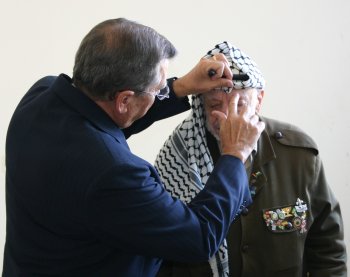
    R.T. prays for President Arafat and anoints him with oil.

    I began praying for Yasser Arafat daily over 22 years ago – never expecting to meet him but because the Holy Spirit laid him on my heart and gave me a love for him. That love has not changed. I don’t know whether Yasser Arafat has ever felt unconditional love from many people, especially from the West, but I want him to feel it from me. I have had one goal: to be Jesus to him.

    John Wesley used to say that God does nothing but in answer to prayer. I don’t mean to be unfair, but if Christians in America had spent as much time praying for Yasser Arafat and Palestinians as they do praying for Israelis and Jews – which can only be right, I believe the situation would be vastly different in the Middle East at the present time. Jesus loves both peoples equally. He would not be political however, he would only demonstrate his love for them.

    Recently Dr. Michael Youssef, the minister of the Church of the Apostles of Atlanta and of the TV and radio ministry ‘Leading the Way’ accepted my invitation to visit Israel and Palestine.. During the first week of September Dr. and Mrs. Youssef and their son Joshua and I journeyed to Israel – mainly to meet President Arafat and the Chief Rabbi of Israel.

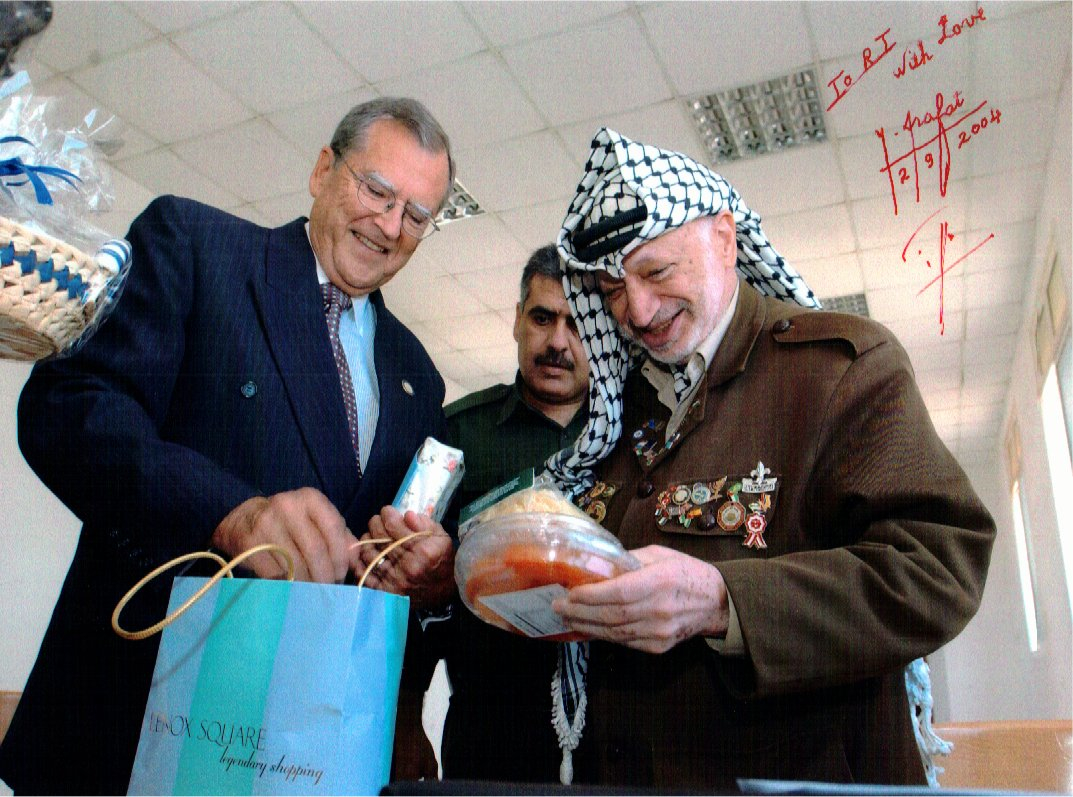
    R.T. presents President Arafat with gifts for his 75th birthday.

    Yasser Arafat had his 75th birthday only days before we saw him on September 2nd. I brought in a Bible – in English and Arabic – which he seemed very pleased to receive, and we gave him also some crystallized fruit that I knew he loves. You will see this in the pictures that are connected to this article.

    Dr. Youssef said to him: ‘The prince of peace was born in this part of the world . . . and we know He is the only one who can gives us peace . . . it is our prayer that He may give you wisdom to achieve peace.’ President Arafat was pleased to receive this word.

    I felt led to share with President Arafat the verses that always govern me when I go into Ramallah: for example, when you are before governors and kings ‘do not worry about what to say or how to say it. At that time you will be given what to say, for it will not be you speaking, but the Spirit of your Father speaking through you’ (Matt.10:18-20). I told him I believe God gives me the words I say to him. I have always sensed the unusual leadership of the Holy Spirit every time I am with President Arafat. On at least two occasions – when I presented the Gospel very strongly to him – I felt I had as much anointing as in any pulpit. But each time afterwards I also feared I would never be invited back. But he has invited me back three times – even to have lunch with him. We had over an hour with him on this occasion. I read Psalm 91:14-16, asked him permission to anoint him with oil and pray for him.

    We were not able to have lunch this time however; all the PLO were fasting in deference to certain men in prison who had gone on a hunger strike. They apologized profusely to us that they could not serve us lunch. Dr. Saeb Erekat, the brilliant and respected Palestinian statesman, who was at my side as I spoke with President Arafat (translating if needed), invited us instead to Jericho where he arranged for a delicious Arabic meal to be set before us. It was fantastic. We were particularly delighted to have well over an hour with Dr. Erekat. Dr. Erekat is highly regarded in the West but also by the Israelis. When the lunch was over we were photographed with him in front of the Catholic school in which he was educated (from age 3 to 12) – then we were photographed together in front of a Sycamore tree that is known to be 2000 years old, just possibly the very tree Zacchaeus climbed!

    The Chief Rabbi of Israel

    During our time in Jerusalem Canon White introduced us to a number of religious leaders, among them the Greek Orthodox Patriarch in the Old City. We then met the Syrian Orthodox Patriarch in the Old City of Jerusalem and had lunch with him and some of the monks there. This took place in what is actually the oldest known church in the world. Later in the day we had coffee and refreshments with the Bishop of the Coptic Church (Egyptian) in the Old City. We also spent time with the Rev and Mrs. Tony Higdon, old friends of mine, the vicar of Christ Church (Anglican) in the Old City. We were privileged to see holy sites seldom if ever seen by tourists.

    It was an honour once again to meet the Chief Rabbi of Israel. We had lunch with him back in March when Lord and Lady Carey, former Archbishop of Canterbury, were with us. He remembered me and greeted us kindly. We had a good dialogue with him. Dr. Youssef said to him, ‘We pray for the peace of Jerusalem . . . for after all we worship your Messiah . . . and we pray for His peace to reign in this land.’

    At that meeting was Rabbi David Rosen, the Jerusalem based International Director of Interreligious Affairs of the American Jewish Committee. I was thrilled that he not only remembered me but said, ‘Hi, R T’ without being re-introduced when we walked in. When we were with Lord and Lady Carey back in March, Rabbi Rosen treated us to a Shabbat dinner in the Mount Zion Hotel. On that Friday evening Rabbi Rosen and his wife and two daughters went through the ancient liturgy for us. It was most moving and brought us to tears. I did not dream that we were in the embryonic phase of what appears to be a significant relationship.

    What happened was this. When Rabbi Rosen had spoken warmly about Pharisees at this Shabbat dinner, I was surprised. To make sure I had not misunderstood him, I asked, ‘Am I to believe that you see yourself as a modern Pharisee and are not ashamed of it?’ He answered that was absolutely the case! I explained to him that nearly all of what Christians know about Pharisees is not very complimentary! He knew this. I told him that I was in the process of writing a book and intended to devote one or two chapters to Pharisees. A few days later he sent me some information on Pharisees. He hoped I would make a distinction between those Pharisees Jesus is recorded as addressing as opposed to most Pharisees – then and now.

    Therefore when we met in Jerusalem recently we agreed to spend more time together. He came early for breakfast the next day. I had just completed my latest book (to be published shortly in England) called Out of Your Comfort Zone – Is Your God too Nice? I told him I had referred to him but not by name lest I embarrass him. He wanted to see what I have written. As we discussed this I came up with an idea. What if we did a book together? We would begin by his criticizing my own interpretation of Pharisees and then I would answer him. He replied, ‘Let’s do it.’ We have since been in dialogue by email and it now appears certain he and I will do a book together. He also gave me permission to mention him by name.

    I want to thank God and also Canon Andrew White for introducing me to important people in the Middle East. Without him I would never have had access to these strategic people. Please pray for him – for his health, wisdom and safety. And pray the same for me as doors continue to be open to me in that troubled spot on our planet.

  • The Christian and the Pharisee

    It was an honor that the book by Rabbi David Rosen and me (with Forewords by Lord Carey, the former Archbishop of Canterbury and Rene-Samuel Sirat, former Chief Rabbi of France) would be launched at Westminster Abbey on March 23rd 2006.

    The meeting ‘by invitation only’ began shortly after 12.30 p.m. David’s wife Sharon and my wife Louise sat next to each other on the front row. The Chairman of the Council of Christians and Jews, who with our publisher Hodder and Stoughton sponsored the meeting, introduced David Rosen and me and asked me to begin with the reason for the book. I explained how I became involved in the Alexandria Peace Process (the architect of which is Lord Carey, former Archbishop of Canterbury and Andrew White, his envoy to the Middle East), developed a personal relationship with Yasser Arafat and then met David Rosen at a Shabbat Meal which he and his wife Sharon hosted in Jerusalem. I recalled how this meeting brought us to tears. But I noted his positive comments about Pharisees that evening, how this amazed me – I gathered David sees himself as a Pharisee, and that a correspondence with him followed. I later proposed to write a book with him – which we now have. I explained that we agreed to be frank in the book, also in our debate – ‘lovingly at each other’s throats!’ The main issues between us were the nature of sin, faith and the Messiah.

    In my opening comments I stated that it is my view that the Jews missed their Messiah 2,000 years ago – namely, Jesus of Nazareth who was born of a virgin, who lived sinlessly for 33 years, fulfilling the Law; that when he died on a cross his blood satisfied God’s justice. We are given assurance of a home in Heaven not by our good works but by transferring our trust in good works to what Jesus has done for us on the cross.

    David Rosen replied that all I just said went right over his head, that it was like hearing ‘from another planet’. He believes that we get to Heaven by our good works, keeping the Law. He added that he is a ‘pluralist’ – that there is more than one way to Heaven.

    I responded by saying there is a ‘double blindness’ on Jews. First, there is the blindness by the ‘god of this world’ (2 Cor.4:4) – on all men, but, secondly, God himself has inflicted on Israel ‘a spirit of stupor, eyes so that they could not see and ears so that they could not hear’ (Rom.11:8).

    We took questions. ‘For whom did you write this book?’ asked Sir Sigmund Sternberg. ‘Is this not a book for schools?’ David Rosen replied: ‘I wrote this book for RT.’ I replied, ‘I wrote this for David’, then adding: ‘I am a fisherman, and I love to catch a big fish’.

    David insisted that there was no likelihood that I would succeed with him. I replied, ‘Who was the most unlikely person to be converted 2,000 years ago? Was it not Saul of Tarsus? And David, with your brilliant mind, God could make you the Apostle Paul of the 21st century’.

    David said, ‘I am a Jew. Jesus was a Jew. I am a Pharisee. Jesus was a Pharisee. RT, I understand Jesus better than you do’. I responded: ‘I challenge you to write another book with me – based entirely on the teachings of Jesus’.

    Anton LaGuardia, the Diplomatic Editor of The Daily Telegraph, expressed the hope that this debate would extend to the inclusion of a learned Muslim in the interest of peace in the Middle East. More than one person expressed this hope to David and me during the day. Mr. LaGuardia, author of Holy Land, Unholy War, wrote a Weblog for The Daily Telegraph the next day which you can read here:

    ‘What do you feel about Messianic believers?’ asked Charlie Colchester. I noted that they generally do not want to be known as Christians, but David thinks Messianic believers should call themselves Christians.

    ‘Why don’t you respect our Law [the Torah]?’ asked one Jewish person present. I replied that I certainly do and that the greatest way one can show respect for the Law of God is to affirm the one who fulfilled the Law – Jesus who fulfilled the Law including the sacrificial system.

    One lady spoke up, ‘I am a Christian, but I find myself agreeing more with Rabbi Rosen than with you’. I replied that I anticipated a comment like that but added, ‘If you wrote back and forth with David I think it would have been a pretty dull book!’

    Each of us was asked, ‘What disappointed you the most in your correspondence?’ David answered that it was my incessant attempts to convert him, that when he got a letter he said to himself, ‘Here we go again’. I said that what disappointed me the most was that, whereas the book began with our interpretation of verses in Isaiah and the Psalms, at some stage David switched to quoting the rabbinic authorities rather than Scripture.

    David wrote this book to help Christians see that Pharisees are not like those described in the New Testament. I pointed out that there was certainly one way in which he was very like the ancient Pharisees; by appealing to the rabbinic authorities rather than Scripture he made the word of God of no effect by his tradition. David replied that Scripture needs to be interpreted and that Christians do this as well.

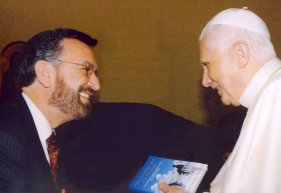
    I closed the day by saying what an honor it was for me to have David Rosen as a friend. That he certainly has indeed made Pharisees look better, and when it is considered that a another reason David had for writing the book was to help Christians see how much Jews dislike attempts of people trying to convert them, he has made himself exceedingly vulnerable in writing this book with me. He is the most distinguished orthodox Jewish rabbi in Israel, was given the first papal knighthood by Pope Benedict. (David gave the pope a copy of our book the week before.) I stated my love and respect for David and I saluted him for what he has done in being willing to write this book with me.

    A number of people present commented that they could tell we love and respect each other.

    Lyndon Bowring, Chairman of Care, observed afterwards that ‘one could not have had a better drama anywhere in the West End’ (London’s theatre district).

    — R T Kendall

  • Accountability and Mercy

    Like many readers of this magazine I have admired Ted Haggard very much. I have had fellowship with him, prayed with him and have been thrilled to see him exalted to such places of influence. He kindly endorsed my book Total Forgiveness (Charisma House). My heart goes out to him and his family. The pain he and they must be feeling at this moment is incalculable. Few people on the planet will undergo the depth of grief and overwhelming guilt that Ted, his wife and children, are experiencing.

    I choose to believe that Ted Haggard is not yesterday’s man. In my book The Anointing (Charisma House) I refer to King Saul as a type of ‘yesterday’s man’: (1) he put himself above the Word of God, knowing full well he was going against Scripture when he offered the burnt offering (1 Sam.13:9). (2) He took himself too seriously, thinking that as King he would be judged by a different standard. (3) He justified what he did, claiming he was ‘compelled’ to do so (1 Sam.13:12). (4) He lost all sense of integrity, even breaking his vow to his son Jonathan (1 Sam.19:6-10). (5) He would repent of trying to kill David; it seemed sincere, but he reverted to the same evil quest (1 Sam.24:16-21, 26:1-4). (6) He turned to the very sin he had officially outlawed in Israel, by turning to the witch of Endor (1 Sam.28:3-11). (7) He was accountable to nobody. He was supposedly accountable to Samuel, but he did not heed Samuel’s counsel.

    What determines whether one is ‘yesterday’s’ man or woman is whether he or she is renewed to genuine repentance. King Saul was not. In Hebrews 6:4-6 there is a description of those who fell away and could not be so renewed. Indeed, it was ‘impossible’ for them to be renewed. The reason for this is very simple: they could not hear God speak anymore. In Hebrews 5:11 the writer warns them that they were already ‘dull of hearing’ (KJV – literally ‘hard of hearing’ – nothroi, Gr.). The worst scenario would be to become what we today would call ‘stone deaf’ – which explains why one could not be renewed to repentance; they could no longer hear God’s voice (cf.Heb.3:7ff). At the natural level, deafness normally comes in stages. So too at the spiritual level. These Hebrew Christians were already in a precarious position – they were ‘hard of hearing’ – as they were being addressed.

    What further determines whether one is renewed to repentance is whether he or she is truly accountable to God. The problem is, too many leaders will say ‘I am accountable only to God – not man’ and consequently feel exempt from submitting to any human leadership on earth. The higher one’s profile, the lower the probability is that such a person will be accountable to any human being. ‘But I am only accountable to God’, one retorts. I reply: if you really are accountable to God, you will prove it by being accountable to honest, frank, responsible, objective, fearless and caring people. You and I are not so spiritual that we can by-pass those people who will lovingly tell us, ‘You cannot do this’, Neither are we so spiritual that we do not need to become exceedingly vulnerable to those who will be unafraid to warn us.

    The problem is, many of us have such people that we trust and claim to be accountable to. But if we do not tell them our weaknesses and temptations, we all, like Ted Haggard, are likely to get caught out sooner or later. God will not bend the rules for any of us. The honor of his name and the reputation of his church do not override his hatred of sin and hypocrisy, wherever it is. For all, things will come out at the Judgment Seat of Christ (2 Cor.5:10); but for some, God steps in in advance of the Judgment.

    Ted Haggard has publicly said that he thanks God he was exposed. I believe him. Strange as it may seem, his getting caught was a kindness of God. I believe that Ted has been chosen as an example of what will happen to all of us if we do not get our private lives in line with the way we are viewed publicly. God has rolled up his sleeves in these last days and said ‘enough is enough’. Secret sins – whether it be pornography addiction, carrying on an affair mentally or physically, improper use of money, not being Christ-like with one’s family – have a way of becoming known. I personally believe that God has decided to step in in order to get Christ’s bride ready in these last days.

    It is no longer surprising for many to hear that pornography is almost certainly the greatest secret sin of preachers. Proof of this is the ratio of sex movies subscribed to in hotels when there are church conventions in town. It is absolutely amazing. They say, ‘No one will know’. Perhaps. But God knows.

    What surely matters most of all for us in the ministry is, in a word: the anointing – the ability given by the Holy Spirit to make the supernatural seem as if it were natural. In other words, the anointing makes it easy. Whereas the gifts and calling of God are without repentance – irrevocable (Rom.11:29), the anointing of God’s abiding approval is in direct proportion to our repentance and walk with the Lord. King Saul prophesied on his way to kill David (1 Sam.19:22-24). This shows that his gift of prophecy was an irrevocable gift and functioned after God rejected him as king (1 Sam.16:1). In the same way the gift of preaching, writing, administration, evangelism and all the gifts of the Spirit in 1 Corinthians 12 may function regardless of one’s secret sins. They prove nothing insofar as being an indicator whether one is walking in the Spirit.

    Recently someone handed me a slip of paper with the following propositions, reportedly written by Dr. Charles Swindoll: (1) Have you been anywhere this week with a woman that may seem compromising? (2) Have your financial dealings this week been conducted with integrity? (3) Have you exposed yourself to any pornography this past week? (4) Have you spent adequate time in the Scripture and in prayer? (5) Have you spent priority time with your family? (6) Have you fulfilled the mandates of your calling or vocation? (7) Have you just lied to me?

    Those people who became yesterday’s men after getting caught were those who did not take recommendations regarding discipline. For example, they could not bear the idea of being out of ministry for a couple of years or more. They have paid heavily as a result. But many of those who have fallen and got exposed who did humbly submit to such discipline – and were granted unfeigned repentance in the meantime – were honored, came back and were mightily used.

    God is merciful. Mercy triumphs over judgment! God knows our frame and remembers that we are dust (Psa.103:14) ‘Those whom I love I rebuke and discipline’, said Jesus (Rev.3:19). Those who choose to be accountable to God and trustworthy people will never become yesterday’s men or women.

    This is why I believe Ted Haggard will come back one day. We should pray for this and welcome the day it happens.

  • “God told me” -Really?

    One of the hardest habits for some of us to break is saying, ‘The Lord told me this’ – or ‘Here is what the Lord showed me’.

    If you ask, Is this truly a bad habit?, I answer: yes. It is one of the worst claims being perpetrated in churches today and is almost certainly a violation of the Third Commandment: ‘You shall not misuse the name of the Lord your God, for the Lord will not hold anyone guiltless who misuses his name’ (Exod.20:7).

    How do you misuse God’s name? By making yourself look God. That is at the bottom of our claims, ‘This is what the Lord told me’. After all, we bring in Him for one reason: to elevate our own credibility. It is not His name we are thinking of, it is our reputation. So if I can add the weight of God’s Name to what I say, it gives me authority and respectability.

    I am not thinking of God’s name and glory at all when I do this – I am thinking of my own.

    Who makes this mistake? Probably, we all do, especially those who have a prophetic gift or aspire to intimacy with God. If they can say, ‘The Lord told me’, we have no choice but to listen! After all, if it is God speaking, I must stand at attention. And if I tell you that ‘God has revealed something to me’, you had better give heed!

    I am not thinking of the accuracy of such claims – at the moment. I am thinking of our motives in making the claims. I can tell you what my motive is if I tell you ‘God told me this’. It is to make you respect what I say.

    The thing is, if God really told me – since I am in a post-canonical age and not writing Scripture, do I need to bring his name into it? In other words, if God himself has shown me something and I pass it along to you, would it not be just as true if I left his name out? My reason for claiming his authority is to elevate my own – in your eyes. Otherwise, I fear you would not listen to me.

    There is no sign in northwest Arizona that says, ‘You are now looking at the Grand Canyon’. When you see it, you know what it is. There are no substitutes or counterfeits when it comes to the Grand Canyon. It would be silly, not to mention that it would cheapen the entire aura, if there were signs reminding us that we are actually looking at the Grand Canyon.

    Therefore if I really have a word from the Lord, I can say it without mentioning his holy Name. It will speak for itself. And if people don’t recognize my authenticity because I don’t bring in God’s name, that is not my problem.

    As for the accuracy of claims when people say, ‘The Lord told me this’, that is quite another story. When you ponder the thousands of times people have made this claim already today – and then get to the bottom of whether it really was the Lord, the angels must be saying, ‘Really?’ God’s Name is brought in for so many ‘words’ that are not from him at all.

    Why do we quote people when we speak? It is to give ourselves a bit more credibility. Certainly that is why I quote Scripture. And if I quote St. Augustine or John Wesley, it is to make you feel that I have a greater measure of reliability on my side. But when I say, ‘The Lord told me this about this verse of Scripture’, I have misused his Name. I have a perfect right to say ‘in my opinion this is what the Scripture means’, but if I say, ‘The Holy Spirit has revealed this to me about this Scripture’, I am not thinking of the Holy Spirit but my own credibility. It is misusing the Spirit – indeed it is abusing his Name.

    Most of us do not like name-droppers. Why do we drop names? If I told you I know Oral Roberts or Billy Graham – or the pope, who would I be trying to make look good? Not them. But when I drop God’s Name in my conversation, writing or preaching, I have in that moment violated a trust which must make the angels blush.

    I am disappointed when a respected prophetic person says, ‘The Lord told me’. Because it cheapens his stature and puts him on the level of all of us who want so much to believe we are hearing from God. We are afraid nobody will believe us so we name-drop God.

    By the way, how would you feel if I told you ‘God told me to write this article?’ Did he? You tell me.

  • Could it really be judgement

    I have been asking the question: whatever is going on lately in some Charismatic circles – the increase of financial scandals, sex scandals, divorces, even Senate investigations of ministries? Could it be God’s judgment? Is there more coming down the road that will make the angels blush? Are people who get found out to continue on as if nothing happened?

    Judgment often begins at the house of God (1 Pet.4:17). It is my view that is precisely what is going on these days. It is because character is more important than gifting. At the Judgment Seat of Christ I will not be judged by how well I preached or how many books I wrote but on the basis of my character. And yet God sometimes steps in here below in advance of the Final Judgment. But what kind of judgment?

    But there are no fewer than five kinds of divine judgment.

    Retributive judgment. This is God getting even and showing no mercy at all. It happened to Cain (Gen.4:13). It happened to Sodom and Gomorrah (Gen.19:28). Eternal punishment is the ultimate display of retributive judgment (Rev.14:11).

    Gracious judgment. This is partly retributive but full of mercy. Whereas retributive judgment is the wrath of God unveiled ‘without mixture’ (Rev.14:`10 – KJV), gracious judgment comes in mercy. ‘Those whom I love I rebuke and discipline’, said Jesus (Rev.3:19). Therefore where there is gracious judgment, painful though it is, there is also hope. That is the wonderful thing about pain; it lets you know something is wrong. The purpose of gracious judgment is to give hope but it is also designed to lead to unfeigned repentance. Gracious judgment is given to warn us. It was at the bottom of Jonah getting found out, being thrown overboard and then swallowed up by the fish. It led to his repentance (Jonah 1-2).

    Redemptive judgment. This too is a mixture; it is partly retribution but is paralleled by a promise. When the children of Israel murmured God sent poisonous snakes which bit the people. But God ordered Moses to make a bronze snake and put it up on a pole. ‘Then when anyone was bitten by a snake and looked at the bronze snake, he lived’ (Numb.21:8-9).

    Natural judgment. This is a variation of retributive judgment , the emphasis being on the consequence of sin. ‘A man reaps what he sows’ (Gal.6:7). There is a natural law at work.

    Silent judgment. This is when God appears to do nothing. This is perhaps the scariest judgment of all. It can be argued when God is the ‘angriest’ he does nothing. This is what we see in Romans 1; God merely ‘gave them over’ to sinful desires and lusts (Rom.1:24,26). It is when God doesn’t send pain; he doesn’t indicate his anger; he doesn’t even send a warning. ‘Ephraim is joined to idols; leave him alone!’ (Hos.4:17).

    We can be thankful that it is not silent judgment at work in recent months. God has instead rolled up his sleeves and has shown his displeasure. But it is gracious judgment that lies behind the ever-increasing number of embarrassing exposures. God has stepped in. He has not been silent. The public exposures are his judgment – but gracious judgment. Make no mistake; he is angry. But there is hope. As pain is a blessing because it shows something is wrong in the body, so God has been finding people out. He is letting people see who has gone wrong.

    Jonah was found out. God got finally got his attention in the belly of the fish. Jonah repented and was used mightily as a result (Jonah 3-4.) ‘The Lord disciplines those he loves’ (Heb.12:6). It means enforced learning.

    ‘For it is time for judgment to begin with the family of God’ (1 Pet.4:17). But it is a good time. God isn’t being silent. He is at work. But if we sweep the dirt under the carpet, and don’t call a spade a spade, it will result in silent judgment one day – which means it is too late. It is not too late – at least not now.

  • Lakeland

    I can think of nothing worse than for God to be powerfully at work and I miss it – all because I was biased and devoid of discernment. All my life I have waited for an authentic work of God that was not unlike the Great Awakening in Jonathan Edwards’ day. In more recent years I have hoped to see the beginning of ‘last day ministries’ – when Isaac succeeds Ishmael – which would precede the Second Coming. God owes me nothing and it may please him to by-pass me entirely in what he chooses to do.

    I wondered if passing me by might be happening with regard to Lakeland. I say this because I have become more and more uneasy with what was going on there. It happens that I watched the Lakeland meetings virtually every night for the last three months. I prayed for the evangelist and for the people there. I would stand before the TV screen and pray for my own healing. I tried very, very hard to support this strange move, especially when some of my closest friends were endorsing it and urging me to do the same. Furthermore, knowing that God loves to do what makes some of us say ‘yuk’, I was prepared all over again for this to happen.

    What complicated things most of all was that people were apparently being healed. At last count there were 37 resurrections from the dead. If only one of them had a coroner’s death certificate it would be a very serious matter to say that what was going on there was not of God. The fact that ABC news could find no documentary evidence of a miracle was not enough to sway me one way or the other. I was even prepared – for a while – to overlook the claim that the angel Emma is the secret explanation for the special revelations and miracles. I believe in angels. What if Emma were a part of the ‘yuk’ factor?

    It took a little bit of courage for me to endorse the Toronto Blessing in 1994. I have never regretted this. I was going to need courage again – to endorse Lakeland.

    But a funny thing kept gripping me. It would take even more courage to say that the Lakeland phenomenon is not of God. Did I have the courage to say this? After all, I was reluctantly coming to the conclusion that it was not of God, but would I say it?

    Yes. It comes to one thing at the end of the day: is the Bible true or not? If the happenings of Lakeland are of God, then what I have preached for the last 50 years is nonsense. Lakeland was making me say ‘yuk’, yes, but not all that makes us say ‘yuk’ is of God.

    First, never once have I heard a clear message of the Gospel of Jesus Christ from the Lakeland platform – except when a guest speaker did it. Second, when people were being baptized in the name of the Father, the Son and ‘Bam – bam’, it both trivialized the Trinity and baptism itself. This is serious, serious trivializing. Third, if you were to ask how much a fear of God and conviction of sin emanated from these services – on a scale of 1 to 100 – I would say zero.

    In 1994 I addressed a group of prominent evangelical leaders in London, having been given the subject ‘The Biblical Features of Revival’. I looked at my notes to see how Lakeland measured up. Not even close. A great awakening would, among several other things I do not have the space to go into here, demonstrate the centrality of biblical preaching. Preaching itself in Lakeland has been minimal, and what preaching there has been calls more attention to angels, miracles and manifestations than to Jesus who died on the cross. I’m sorry, but my heart is sick that these meetings have excited so many good people. They are indeed good people, very sincere; many of them have been a part of previous moves of the Spirit. And since church history has taught us that those who were in the middle of a move of the Spirit often lead the way in opposing the next work of the Spirit, some did not want to be seen doing this. I can understand that.

    When one is reported to have been to the Third Heaven (as the main evangelist of Lakeland has stated) and told not to preach Jesus (because everybody knows about him) but rather angels (which people know little about), I can only call this ‘another gospel’ as in Galatians 1. I would go to the stake for the Gospel of salvation which Paul preached – that emphasizes reliance solely in the precious blood of Christ. I would certainly not go to the stake for the Lakeland message – and would be afraid to face God if I did.

    It comes to this: is the Bible true? Because I believe the Bible I can testify: the jury of my mind on Lakeland is in. Leave Lakeland alone.

  • Whatever Happened to Discernment?

    I believe in all the gifts of the Spirit, and yet I fear there is a scarcity of that underestimated gift called discerning of spirits (1 Cor.12:10). Many of us truly want the supernatural; but there seems to be little evidence of a seeking after the gift of discernment.

    The task of every generation is to discern in which direction the Holy Spirit is moving, then move in that direction. Whatever else is true, it is a time when people ‘will not put up with sound doctrine . . . they will gather around them a great number of teachers to say what their itching ears want to hear’ (2 Tim.4:3). The world is going to hell and we not only help send them there but make them feel good on the way.

    So much teaching nowadays seeks a ‘feel good’ reception. No stigma, no offense of the cross, no appeal to self-denial, little that is God-centered but what will – even if unintended – keep people asleep, undiscerning, blind and impervious to the real and present danger. I don’t mean to be unfair, but what would preaching be like if there were no need for people’s approval or financial support?

    Healing, miracles and prophecy naturally fascinate us – unless it is a word of knowledge that exposes our sin. And if we really believe in the spiritual gifts, whatever happened to discernment? We should eagerly desire it in order to make a distinction between the real and the counterfeit – not to mention discovering he Spirit’s mind. What worries me is that the people without discernment seek after and accept teaching that is truly harmful.

    ‘My people are destroyed from lack of knowledge’ (Hos.4:6). There is a diminishing of biblical, theological and spiritual knowledge in the pew, pulpit and various platforms – and nobody seems to notice when the ‘emperor has no clothes’! Undiscerning leaders can endorse an immature preacher before the world and prophesy extraordinary things – which turn out to be completely wrong, and hardly anybody says a word! And we wonder why the world does not respect us!

    The New Year is a good time for resolutions. One of the best resolutions would be to read the Bible through in a year and pray more. My mentor Dr. Martyn Lloyd-Jones introduced me to a Bible reading plan devised by Robert Murray M’Cheyne 32 years ago. Until then I had no plan, I am ashamed to say. I have also been surprised how many church leaders do not read their Bibles. A recent survey showed the average church leader spends not an hour a day (which should be the minimum) but only four minutes a day in quiet time.

    Jesus said to the Pharisees, ‘You know how to interpret the appearance of the sky, but you cannot interpret the signs of the times’ (Matt.16:3). Are we any different? A balanced diet of sound biblical, theological and spiritual knowledge would result in discernment.

    We lack discernment partly because we are asleep. Jesus prophesied that in the last generation the church would be asleep (Matt.25:5). As you know, three things characterize sleep: (1) we don’t know we were asleep until we wake up; (2) we do things in our dreams we would not do when awake; (3) we hate the sound of an alarm.

    Jesus also forecast a midnight cry (Matt.25:6) meaning ‘middle of the night’, which is: (1) the darkest time; (2) when we are the deepest in sleep; and (3) when we are least expectant. Could not this wake-up call come in stages, 9/11 being the first stage? Yes. If the recent economic melt-down is not a further wake-up call I don’t know what is. But the ultimate and final wake-up call will categorically cause the church to discern their true condition, except that for some it will be too late (Matt.25:8-13).

    We are in the middle of the night. Right now. It is dark. The church is in a deep, deep sleep. We do things we would not do when awake. Lord, grant us discernment before it is too late!